
Why Independent Commercial Elevator Companies Are Invisible in AI Search Results
Published October 6, 2026 by Patty Hong
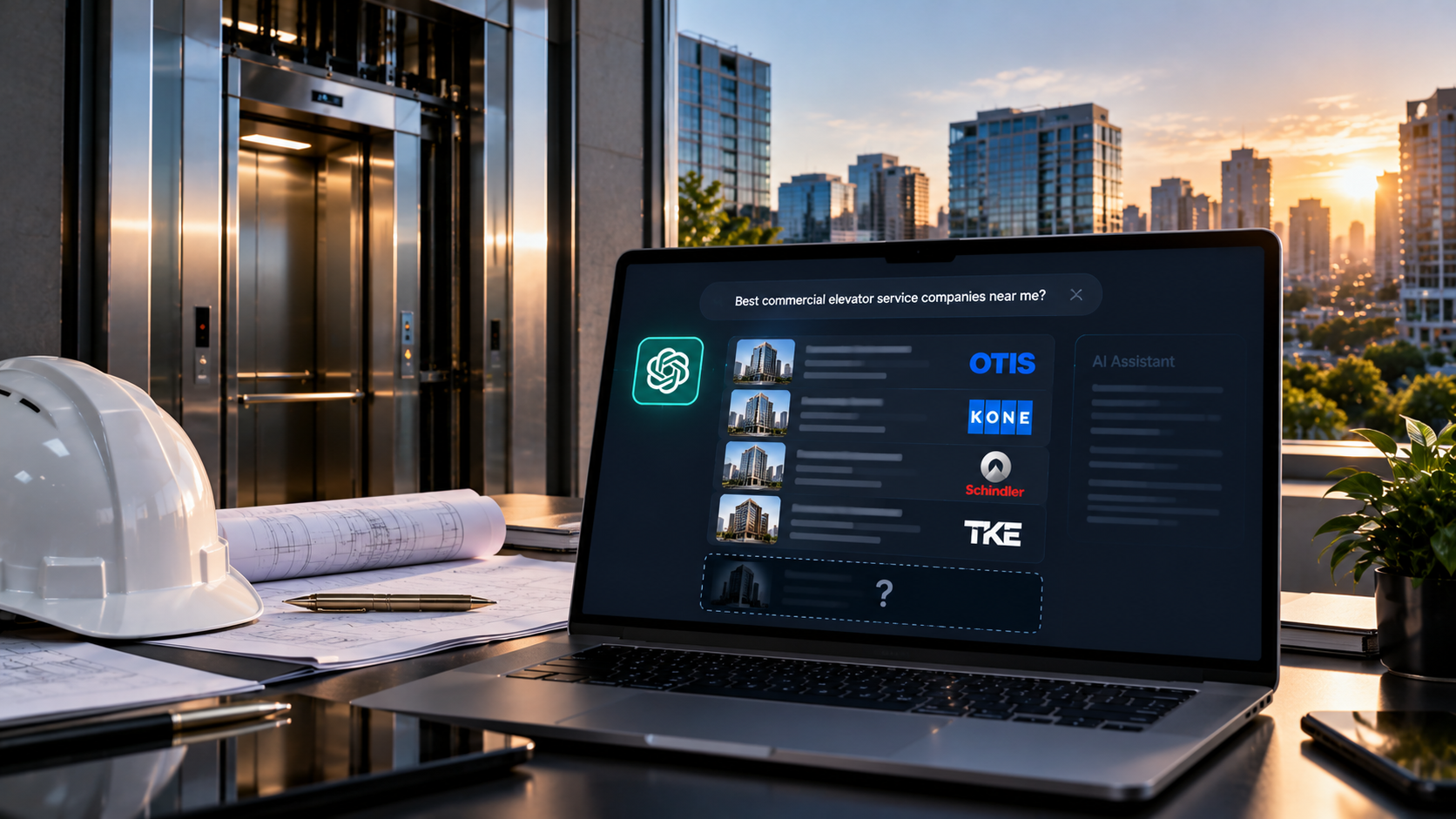
Independent elevator contractors are losing commercial contracts to Otis, Schindler, KONE, and TKE not because those companies outperform them on service, but because AI assistants can't find them. AI optimization restructures your credentials, equipment capabilities, and territory data into formats that AI retrieval systems can read, verify, and cite when property managers request contractor recommendations.
Key Takeaways
- When property managers ask AI assistants for elevator contractor recommendations, the Big 4 OEMs appear by default because their data is structured for machine retrieval. Most independents aren't.
- Google rankings and AI visibility operate on entirely different mechanisms. A strong SEO presence doesn't protect you from being invisible in AI-generated answers.
- Your trade credentials, service territory, and equipment capabilities need to be structured in formats AI systems can attribute with confidence, not just presented on a website written for human readers.
- The gap between your actual service capability and what AI systems can describe about you is the exact problem AI optimization closes.
- A free territory audit shows you where you stand in your specific market's AI results before you commit to anything.
Why Are You Still Losing Contracts to the Big 4?
You respond faster than the OEMs. Your technicians take the time to give each building the attention it deserves. Your renewal rate tells the real story. And yet a property manager three miles away just signed a maintenance contract with Otis.
Here's the mechanism. That property manager didn't open a browser and type a query. They asked an AI assistant something like "what are the best commercial elevator service companies near me?" The AI generated a confident answer in seconds. Otis made the list. Your company didn't appear at all. The decision was made before you had any chance to compete.
This isn't a service quality problem. It's a data structure problem.
AI assistants build recommendations by pulling from structured entity data: machine-readable credential signals, defined service zones, and content formatted so that attribution is confident and specific. The Big 4 have years of corporate web infrastructure built precisely for that kind of retrieval. Your service record, no matter how strong, lives in relationship history, technician knowledge, and a website designed for people to read rather than for AI systems to parse and repeat with certainty.
The contracts walking out the door aren't going to better operators. They're going to companies whose data is formatted for a world your business isn't yet visible in.
What Does AI Optimization Actually Mean for Your Business?
AI optimization, in the context of commercial elevator contracting, means restructuring your credentials, capabilities, and territory coverage into the specific formats that AI retrieval systems treat as authoritative when they build recommendations.
That's a fundamentally different task from search engine optimization. SEO improves your position when someone types a query into Google. AI optimization changes whether you appear at all when an AI assistant synthesizes an answer. The signals are different, the data structures are different, and the failure mode is different too.
Think about how AI retrieval actually works. An AI assistant doesn't rank links the way a search engine does. It constructs a summary by extracting and attributing data from sources it can parse with confidence. To cite your company, it needs to be able to identify you as a named entity, connect that entity to specific credentials, map your service zone to the query's geography, and confirm your equipment capabilities in structured form. If any of those pieces are missing or buried in unstructured text, the AI passes you over, not because you don't qualify, but because it can't confirm that you do.
Consider a typical scenario. A facilities manager overseeing a mid-size commercial real estate portfolio asks an AI assistant for elevator maintenance contractors in their metro. The AI returns two or three names it can describe with precision: brands with named equipment types, defined service zones, and verifiable credentials in machine-readable form. An independent contractor in the same city, with faster response times and genuine modernization expertise, doesn't appear because nothing about that contractor is structured in a way the AI can attribute with confidence. That's the gap. And that's exactly what the BeFoundInAI territory audit is designed to map in your specific market.
Won't My Google Presence Cover This?
No. This is where many contractors are getting quietly hurt right now, and it's worth being direct about why.
Google search and AI-generated recommendations are separate buyer channels with separate data requirements. Google ranks pages. AI systems construct answers. The process of appearing in a Google result tells you nothing about whether you're appearing in an AI assistant's recommendation output. A contractor with a genuinely strong SEO presence can still be completely absent from AI-generated answers because the two systems ingest and weigh data differently.
Here's the practical distinction. When someone Googles "elevator maintenance contractors Chicago," Google returns a ranked list of links and your job is to appear on that list. When someone asks an AI assistant the same question in conversation, the AI synthesizes an answer and names specific companies it can describe with verifiable specificity. If it can't attribute credentials, territory, and capabilities to your company with confidence, it doesn't name you. It names whoever it can describe precisely.
This is why contractors with well-maintained websites and solid Google Business profiles still find themselves absent from AI recommendations. Those assets were built for a search-based buyer behavior. They weren't built for machine retrieval.
Getting AI visibility right requires different infrastructure work: understanding how AI systems ingest entity data, what credential structures they treat as authoritative, and how geographic service zones need to be described to register as territory-specific answers. That work is what BeFoundInAI was built exclusively to deliver for independent elevator contractors.
The Four Dimensions AI Systems Use to Recommend Contractors
Most independent contractors have visibility gaps across the same four areas. Understanding where those gaps exist in your data is the starting point for closing them.
Each row is a reason an AI assistant passes you over. Not because you're unqualified. Because it can't confirm that you're qualified. The work BeFoundInAI does addresses every row in that table, specifically for the credential structures, building types, and query patterns that apply to commercial elevator contracting.
What Realistic Outcomes Look Like
AI visibility isn't a switch. It's a positioning process that builds as AI systems incorporate updated entity data and structured signals across their retrieval layers. Expecting immediate results would be misunderstanding how the mechanism works.
Realistic progress looks like this: your credentials, service zone, and equipment capabilities get restructured into formats AI systems can read and attribute. Over the following weeks and months, AI assistants querying for contractors in your territory have verifiable data to work with. The gap between your actual capability and what AI can describe about you narrows. Property managers who never found you through referrals or Google start encountering you through a channel that didn't exist for your business before.
One genuine limitation to name: if your territory already has dense, well-structured competitor data, building authority takes longer. The earlier you address this, the smaller the hill you're climbing. Waiting doesn't keep the competitive landscape static. It lets other contractors build authority while yours stays unmapped.
What this approach won't do: it won't repair a weak service reputation, it won't generate leads in markets where you have no operational presence, and it won't close contracts on its own. AI visibility gets you into the conversation. Your technicians and your service record close it.
If you want to see your actual standing in your territory's AI results before committing to anything, the territory audit gives you that picture first.
Who Gets the Most From This
This matters most for established independent commercial elevator companies already winning on service quality and competing actively for maintenance contracts and modernization jobs in a defined territory. If you're a residential-only operation or a single-technician setup without capacity for new commercial accounts, the infrastructure isn't right-sized for where you are yet.
It's also not a short-term advertising campaign. This is structural positioning work. The value builds as your entity data becomes more authoritative in AI systems over time. It compounds. Contractors who invest in it now in their specific territories are building a positioning advantage that gets harder to displace the longer it's in place.
The contractors best positioned to benefit already know they're the better option in their market. Their frustration is that property managers starting their research through AI never find out. Learn more about the approach at befoundinai.com/about.
FAQ
How is this different from what my current SEO company does?
SEO structures your website to rank in Google results when someone types a query. AI optimization structures your entity data and credential signals so AI assistants can extract, verify, and cite your company when constructing recommendations. They address different buyer behaviors and use different underlying signals. Most SEO providers aren't building for AI retrieval because it requires understanding how AI systems ingest entity data, not how Google's crawlers index pages. The two aren't interchangeable.
How long before I see results in my market?
There's no single honest answer because it depends on your territory's competitive density and how much structured data currently exists about your company. The positioning work propagates into AI systems over weeks. Inbound contacts don't follow a predictable schedule, and anyone offering a specific guarantee is misrepresenting how these systems work. What you get is a clear baseline from the territory audit and a process designed to close the gap over time.
Will this work in my specific service area?
The work is calibrated to your territory, not applied as a generic national template. The territory audit shows you the current state of AI visibility in your specific market before any commitment is made. What's true in one metro can differ significantly from what's true in another.
My local reputation is strong. Won't AI systems pick that up automatically?
Local reputation built through relationships, referrals, and Google reviews isn't automatically legible to AI retrieval systems. AI assistants construct answers from structured, machine-readable data. The fact that your existing clients would recommend you without hesitation doesn't register in AI outputs unless that credibility is translated into formats AI systems can parse and attribute. That translation is precisely the work being done here.
What makes BeFoundInAI different from a general digital marketing agency?
BeFoundInAI works exclusively with independent commercial elevator contractors. The credential structures, equipment capability signals, and commercial building query patterns that produce AI visibility in this industry are specific to elevator contracting. A general agency won't distinguish between a hydraulic modernization job and a traction drive upgrade. That specificity is what makes AI positioning credible to the systems evaluating it, and it's what makes the approach different from generic digital marketing.
Does this replace my website or existing marketing?
No. Your website, Google Business profile, and direct outreach still matter for the buyers they reach. AI optimization addresses the buyer behavior those tools don't reach: the property manager who asks an AI assistant instead of running a search. The two work alongside each other rather than competing.
How do I find out where I actually stand right now?
The starting point is the free territory audit. It maps where your company is visible and where it's absent in your specific market's AI results, covering the query types property managers are actually using. You get a concrete picture of your current standing before deciding anything. Request your territory audit to start there.
The property managers writing your next contracts are already asking AI for recommendations. The only question is whether your company appears when they do. Contact BeFoundInAI to find out exactly where you stand.
Delivered within 2–3 business days. 100% free, no obligation.
About BeFoundInAI:
Patty Hong, Founder
I create educational content for independent commercial elevator contractors navigating AI search, online visibility, and digital authority in their territory. My work focuses on helping independent contractors understand how their businesses are represented and discovered across AI-powered search platforms.